
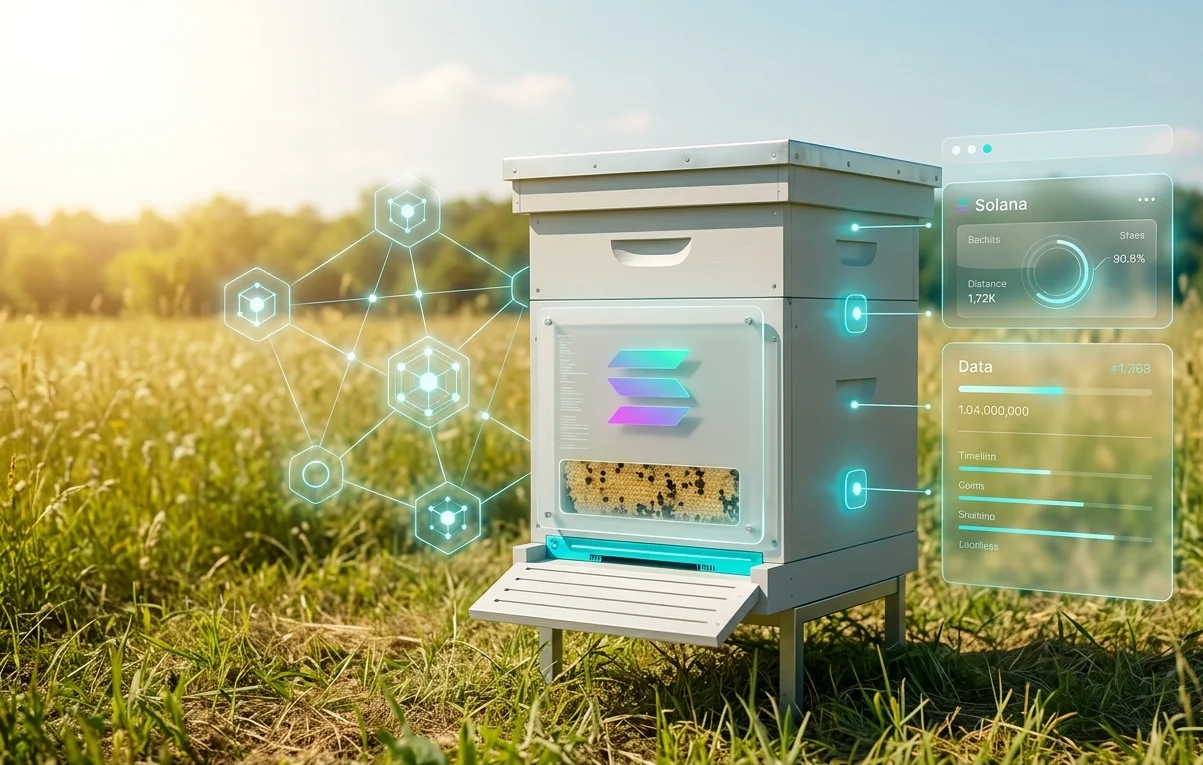
Tokenization of Real World Assets in Beekeeping
The integration of blockchain technologies into the traditional agro-industrial sector is moving from theoretical concepts to practical implementation. A project in Serbia demonstrates the mechanism of converting a physical apiary into a digital asset using the RWA (Real World Assets) standard. Utilizing the Solana network has minimized transaction costs and ensured high-speed data processing, which is critical for microtransactions and the continuous updating of telemetry from sensors.
Architecture of the Monitoring System
The core of the project is the hardware complex installed directly inside the beehives. This is not merely a digital certificate of ownership, but a fully-fledged Internet of Things (IoT) ecosystem. Each hive is equipped with low-power microcontrollers that collect data in real-time. Information is transmitted via the LoRaWAN protocol to a central gateway, and from there to servers for subsequent hashing and recording on the blockchain.
- Strain gauge sensors record changes in the weight of the hive, allowing the estimation of the volume of collected nectar.
- Internal and external thermometers monitor the microclimate, warning about the risk of overheating or overcooling of the colony.
- Hygrometers measure the humidity level, which affects the honey maturation process.
- Acoustic sensors analyze the buzzing frequency, which helps detect the bees’ preparation for swarming or the presence of diseases.
Blockchain Components and Smart Contracts
The choice of the Solana network is justified by its architectural advantages for projects requiring high-frequency state updates. The Proof of History protocol provides a reliable chronology of events, essential for auditing the status of the hives. Each physical hive is represented by a unique Metaplex standard NFT, containing metadata linked to specific geographic coordinates and IoT module serial numbers.
The smart contract automates profit distribution. When a batch of honey is sold on the real market, fiat funds are converted into stablecoins (e.g., USDC). Following this, the smart contract automatically distributes dividends in USD among NFT holders in proportion to their share or the productivity of the specific hive to which the token is linked. This eliminates the need for intermediaries and makes financial flows completely transparent.
Economic Model and Profitability
The financial attractiveness of RWA projects relies on backing tokens with real liquidity. In the case of a tokenized apiary, the underlying assets are honey, wax, and propolis. An average hive generates between 20 and 40 kilograms of commercial honey per season. Assuming a wholesale price of eco-friendly product at 5-8 USD per kilogram, one hive can bring about 150-300 USD of basic revenue per year, excluding the value of pollinating nearby agricultural lands.
Token holders gain access to a dashboard that displays not only financial statistics but also predictive analytics. Machine learning algorithms process acoustic and temperature data, forecasting the honey yield volume with up to 85 percent accuracy weeks before the extraction begins.
Prospects for Scaling the Format
The pilot project in Serbia paves the way for standardizing tokenization in the agricultural sector. A similar approach can be applied to vineyards, orchards, or aquaculture farms. The main challenge at the current stage is the regulatory framework. EU legislation regarding crypto assets (MiCA) requires clear classification of such tokens, which may necessitate obtaining additional licenses for platform operators.
From a technical standpoint, developers are planning integration with oracles that can fetch real-time data on weather conditions and market prices for honey. This will enable the creation of dynamic NFTs, whose visual characteristics will change depending on the health of the bee colony and its current financial balance.



0 Comments