
- Shell Genetics and Pigmentation: Why Color Does Not Affect Quality
- Shell Anatomy: Porous Structure and Physics of Gas Exchange
- Egg White Biochemistry: Denaturation and Protein Matrix
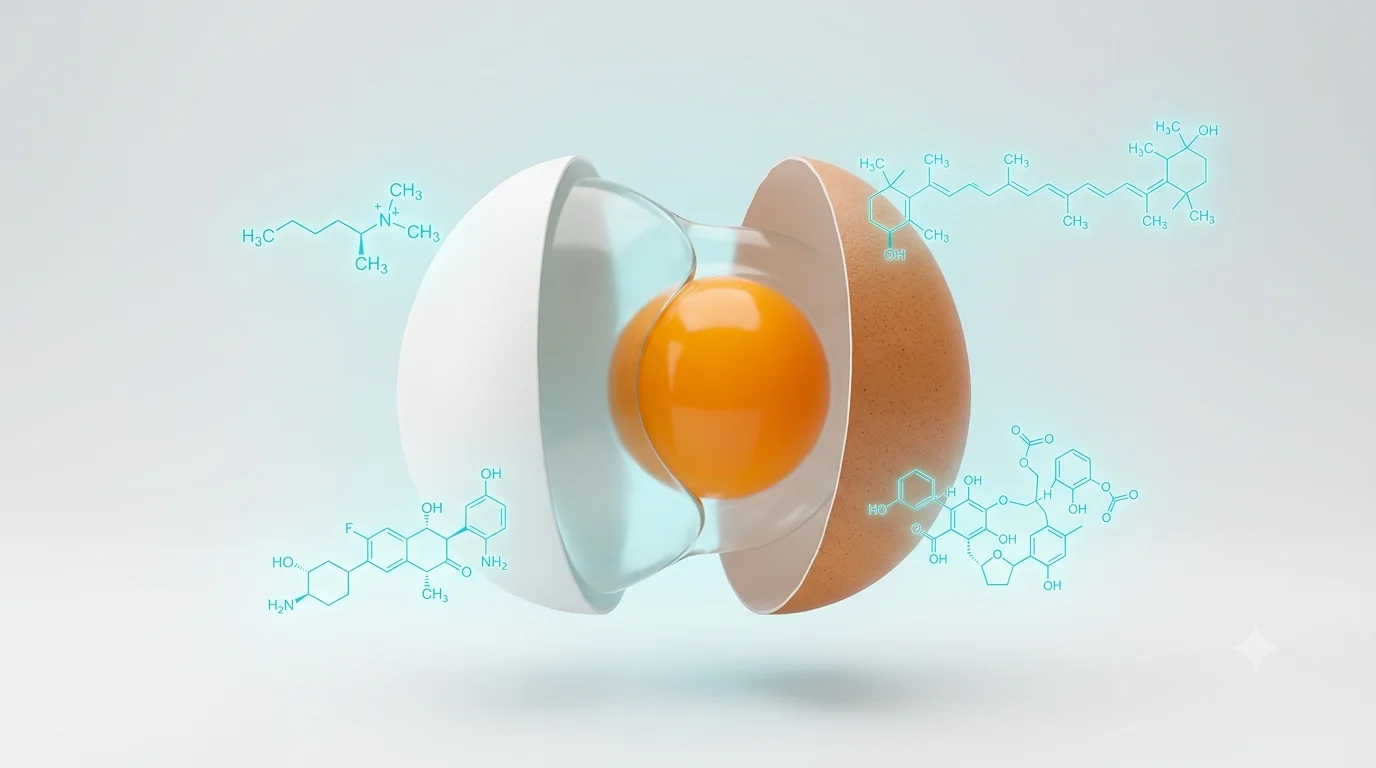
- Yolk Nutritional Profile: Choline, Carotenoids, and Lipids
- Reevaluating Dietary Cholesterol: Modern Evidence
- Microbiological Safety and Iron-Sulfur Reactions
Shell Genetics and Pigmentation: Why Color Does Not Affect Quality
For a long time, a common belief has persisted that brown chicken eggs are healthier, more natural, or superior to white ones. From biochemical and physiological perspectives, this assertion has no scientific basis. Shell coloration is determined exclusively by the genetic characteristics of the hen breed. Hens with white feathers and white earlobes (such as the Leghorn breed) lay white eggs, whereas breeds with red or dark plumage (such as Rhode Island Red or Plymouth Rock) lay brown eggs. Specialized breeds, like Araucana, lay eggs with blue or greenish shells.
Egg formation in a hen takes approximately 24 to 26 hours, with pigment deposition occurring in the final stage of shell secretion in the oviduct. For brown eggs, the primary pigment is protoporphyrin IX, derived from hemoglobin synthesis and deposited by uterine glands. In blue or green eggs, biliverdin-a bile pigment-is responsible for the coloration. Beneath the thin pigmented outer layer, the basic shell structure remains identical across all breeds, composed of a crystalline matrix of calcium carbonate (CaCO3) making up about 95% of its total mass, supported by an organic protein matrix.
Price disparities between white and brown eggs in retail stores stem from agricultural economics rather than nutritional value. Brown-egg laying breeds are typically larger, requiring more feed for body maintenance, which slightly increases production costs. Furthermore, marketing strategies capitalize on consumer perception of brown eggs as more “rustic” or “natural,” applying premium pricing.
Shell Anatomy: Porous Structure and Physics of Gas Exchange
Despite appearing solid, a chicken eggshell is a porous biomaterial. A single average shell features between 7,000 and 17,000 microscopic pores. These pores facilitate respiratory gas exchange for a developing embryo, allowing oxygen (O2) influx while carbon dioxide (CO2) and water vapor escape. The highest concentration of pores is situated at the blunt end of the egg, where the internal air cell is located.
Freshly laid eggs are coated with an organic layer known as the cuticle (or bloom). Composed of proteins, lipids, and carbohydrates, the cuticle acts as a physical barrier against microbial invasion, including Salmonella species. Beneath the shell lie two shell membranes-outer and inner. When laid, an egg has a body temperature of roughly 41 °C. As it cools to ambient temperature, the internal liquid contents contract, drawing air through the pores to form the air cell between the two membrane layers at the blunt end.
Over time, moisture continuously evaporates through the pores, causing the air cell to expand. This physical process underpins the standard water float test used to estimate egg age:
- Fresh Egg (1-7 days): Contains a tiny air cell, maintaining high overall density, and sinks flat to the bottom of a water container.
- Slightly Aged Egg (7-21 days): Water loss expands the air cell, causing the blunt end to tilt upwards while remaining grounded.
- Old Egg (over 21-30 days): Significant water evaporation reduces average density below that of water, allowing it to float.
It is crucial to note that the water test evaluates physical dehydration and age only. It does not measure microbiological safety or detect bacterial contamination if the cuticle is compromised.
Egg White Biochemistry: Denaturation and Protein Matrix
Egg white (albumen) constitutes approximately 60% of total egg mass and consists of 88-90% water. The remaining 10-12% comprises a complex protein matrix containing over 40 distinct proteins. Ovalbumin is the predominant fraction (54-65%), providing nutritional amino acids and foam stabilization. Conalbumin/transferrin (12-13%) sequesters iron ions to inhibit microbial growth. Additional proteins include ovomucoid (11%), globulins (8%), lysozyme (3.5%), and ovomucin (1.5-3%).
In its native state, albumen proteins exist in compact globular forms held by hydrogen, disulfide, and ionic bonds, rendering the liquid transparent. Thermal energy breaks these weak non-covalent bonds-a process called denaturation. Unfolded protein chains interconnect randomly to form a semi-solid three-dimensional network (coagulation).
This protein matrix traps water molecules within its network. However, extended exposure to high temperatures (boiling at 100 °C) causes excessive matrix contraction, squeezing water out through syneresis and resulting in a tough, rubbery texture. Denaturation can also be induced via mechanical shearing (whisking) or acidification (adding acids like vinegar).
Yolk Nutritional Profile: Choline, Carotenoids, and Lipids
The yolk accounts for roughly 30% of egg mass while delivering over 75% of its total caloric value alongside essential fat-soluble nutrients. It consists of 50% water, 16% protein, 30% lipids, and 4% carbohydrates and minerals. The lipid fraction contains triglycerides, phospholipids (predominantly lecithin), and cholesterol.
Yolk serves as one of the richest dietary sources of choline (Vitamin B4). A single large egg yields approximately 140-150 mg of choline, covering over 25% of the daily adult requirement. Choline is a crucial precursor for acetylcholine, a key neurotransmitter governing memory, cognitive performance, and neuromuscular control.
Furthermore, yolks store fat-soluble vitamins (A, D, E, K) and antioxidant carotenoids, primarily lutein and zeaxanthin. Yolk pigmentation (ranging from pale yellow to deep orange) reflects dietary carotenoid intake in laying hens (such as yellow corn, alfalfa, or marigold extracts). Yolk color does not indicate superior nutritional value or organic farming status.
Reevaluating Dietary Cholesterol: Modern Evidence
For decades, egg yolks were restricted due to their cholesterol content (~180-200 mg per egg). It was hypothesized that dietary cholesterol directly raised serum cholesterol and accelerated cardiovascular disease risk.
Modern clinical studies have revised this framework. Major health organizations (including the AHA and EFSA) have removed strict dietary cholesterol limits for healthy individuals based on homeostatic physiological mechanisms:
- Endogenous Synthesis: The human liver produces 800-1200 mg of cholesterol daily for membrane assembly, hormone synthesis, and bile acid production.
- Feedback Inhibition: Increased dietary cholesterol intake triggers down-regulation of endogenous hepatic synthesis in healthy subjects.
- Lipoprotein Balance: Yolk phospholipids support high-density lipoprotein (HDL) formation, preserving vascular integrity.
Microbiological Safety and Iron-Sulfur Reactions
The main biological hazard associated with raw eggs is Salmonella enteritidis infection. Salmonella cannot be detected visually or through float testing. Food safety protocols require refrigeration below 4 °C and thorough thermal processing reaching internal temperatures of 70 °C.
The greenish ring around overcooked egg yolks is harmless ferrous sulfide (FeS), formed when sulfur from albumen proteins reacts with iron in the yolk under prolonged heating.




0 Comments