
- A New Computing Paradigm Unveiled in Singapore
- Architecture and Hardware Components of the CL1 Platform
- Silicon and Biology Interaction Interface
- Energy Metrics and Challenges of Modern Data Centers
- Biological Learning Features and Synaptic Plasticity
- Technical Challenges and Limitations of the Technology
- Sterility and Maintenance Automation
- Reproducibility of Computational Results
- Future Outlook and Ethical Considerations
- Sources of Cellular Material
- Bioethics and Regulatory Aspects
- Current Status and Development Roadmap
A New Computing Paradigm Unveiled in Singapore
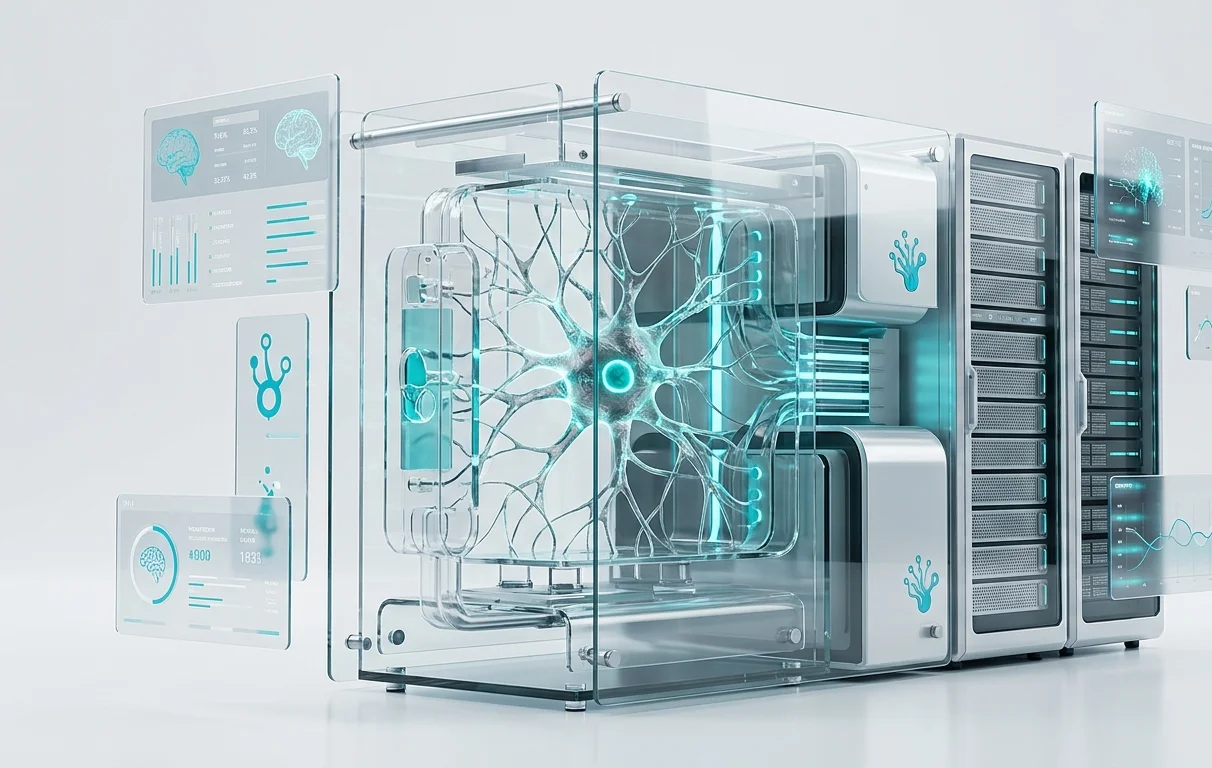
At the National University of Singapore, a data center prototype combining 16 million lab-grown human neurons with traditional silicon infrastructure was demonstrated. Systems of this type are categorized as wetware computing (computing on organic matrices). The primary goal of the project is to create computing modules capable of processing artificial intelligence tasks with minimal energy consumption.
The project was implemented by Cortical Labs in collaboration with research institutes. The core idea is to leverage the high plasticity of biological neurons to optimize machine learning processes. Instead of mathematically simulating neural networks using powerful graphics processors, developers use physical biological cells that react to electrical impulses.
Architecture and Hardware Components of the CL1 Platform
The server rack of the Cortical Labs CL1 system consists of 20 individual computing units. Each unit is equipped with a specialized biological processor. The processor itself is a microelectrode array housing approximately 800,000 living neurons derived through stem cell differentiation.
The cells reside in sealed microfluidic chambers with a precisely controlled environment maintained at 37 °C, specified humidity, and a continuous supply of nutrient solutions. An automated life support system is used to remove metabolic waste and deliver oxygen.
Silicon and Biology Interaction Interface
Communication between digital microchips and the biological environment is established via a high-density microelectrode array. Specialized software translates input digital data into a sequence of electrical stimuli. These impulses are applied to specified groups of neurons.
Neurons respond to stimulation by altering internal potentials and generating corresponding electrical spikes. Cell responses are read by adjacent electrodes, after which a signal processor converts them back into digital code for further processing by computer systems.
Energy Metrics and Challenges of Modern Data Centers
Modern data centers dedicated to artificial intelligence workloads consume gigawatts of electricity. Large clusters based on graphics processing units require continuous active cooling and substantial network infrastructure. The energy crisis in computing capacity forces the exploration of novel hardware architectures.
The human brain consumes around 20 W of power while performing complex analytical tasks. By comparison, a supercomputer requires megawatts to model a similar number of synaptic connections. The biological data center in Singapore demonstrates a power draw of 800-1000 W for a 20-unit rack, which is significantly lower than traditional servers operating for similar tasks.
Biological Learning Features and Synaptic Plasticity
Traditional deep learning algorithms require numerous backpropagation cycles across massive datasets, leading to high resource expenditure. Biological neural networks operate based on the principles of free energy minimization and synaptic plasticity.
When system feedback is provided via electrical impulses, neurons independently restructure intercellular connections. This enables the organic system to adapt to changing conditions in real time without reloading weight coefficients, as occurs in classical machine learning models.
Technical Challenges and Limitations of the Technology
Using organic materials in computer engineering introduces specific challenges. The primary factor is the finite lifespan of cells and their sensitivity to environmental variables. Changes in pH levels, temperature fluctuations, or microbial contamination lead to biological processor degradation.
Sterility and Maintenance Automation
Ensuring continuous operation of the server rack requires full automation of nutrient solution delivery. Replacing spent media must occur without compromising the internal sterility of the modules. Any interruption in the life support system lasting a few hours causes widespread cell death.
Reproducibility of Computational Results
Unlike digital transistors operating with clear binary states (0 and 1), biological neurons exhibit probabilistic behavior. Two identical biological processors may react differently to the exact same input signal. This complicates computation standardization and result verification.
Future Outlook and Ethical Considerations
Further development of wetware computing involves creating hybrid systems where biological units act as primary signal analyzers or neuromorphic coprocessors. This setup can reduce workloads on classical processors in pattern recognition and time-series processing tasks.
Sources of Cellular Material
Cortical Labs projects utilize induced pluripotent stem cells. This technology allows neurons to be generated from ordinary skin or blood cells of adult donors, eliminating the need for embryonic tissues and resolving major ethical concerns.
Bioethics and Regulatory Aspects
As the cell count per system increases, scientific discussions arise regarding the boundary between simple cellular ensembles and complex biological structures. International scientific organizations are developing guidelines defining acceptable biomass volumes and operational scopes for such computing modules.
Current Status and Development Roadmap
At this stage, the Singapore prototype serves as an experimental testbed for research hypotheses. Scientists are evaluating system stability under prolonged loads and developing new programming paradigms for biological matrices. Widespread deployment of such solutions into enterprise data centers will require overcoming numerous technological and logistical hurdles over coming years.


0 Comments