
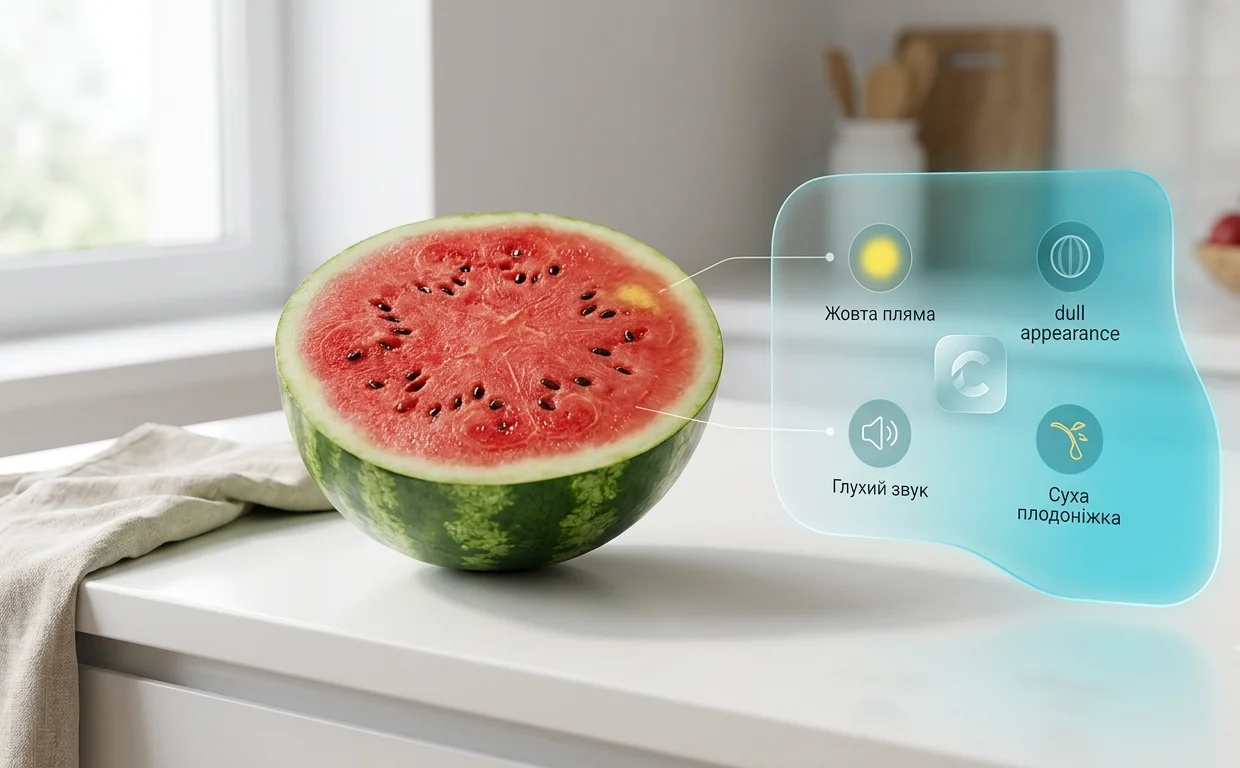
Why Choosing a Sweet Watermelon Involves Physics and Botany
Selecting a watermelon can feel like a guessing game, but fruit maturation follows clear biological and physical rules. Watermelons belong to the non-climacteric category of fruits, meaning they stop ripening once detached from the vine. If harvested prematurely, the sugar level remains locked, regardless of how long the fruit sits on a store shelf.
Botanical maturity brings distinct structural and chemical transformations. As sugars like fructose accumulate, cell sap density increases, and chlorophyll breakdown at the contact point with the ground creates visible color shifts. Evaluating external markers allows consumers to determine internal quality with high accuracy.
2>The Field Spot as a Primary Maturity Indicator
The ground spot, or field spot, is the area where the watermelon rested on the soil during growth. Deprived of direct sunlight, chlorophyll decomposes naturally in this region, revealing underlying carotenoid pigments.
- Coloration: Unripe melons display a stark white or pale greenish spot. A fully matured watermelon develops a rich creamy-yellow or buttery-orange ground spot.
- Sizing: The ideal field spot measures roughly 2 to 4 inches in diameter. Oversized spots may indicate uneven sun exposure, while minimal spots suggest premature harvesting.
A deep yellow field spot confirms the fruit remained on the vine long enough to complete its natural sugar synthesis cycle under adequate sunlight.
Acoustic Resonance and Density Testing
Tapping a watermelon is an effective method for evaluating its internal structure. As the fruit matures, internal water distribution changes, affecting how sound waves propagate through the flesh.
When knocking on the rind with knuckles, listen for specific acoustic feedback:
- Deep hollow resonance: Indicates firm, liquid-dense flesh without internal cavities or overripe structural collapse. Sound waves bounce cleanly off solid walls.
- High-pitched metallic ring: Common in under-ripe melons where water content is present but cellular sugar structures remain underdeveloped and overly rigid.
- Dull, flat thud: Signals an overripe fruit that has lost internal moisture, resulting in mealy texture or internal air gaps.
Rind Finish and Sugar Webbing
The exterior finish of a watermelon reflects its growing conditions and sugar concentration. Contrary to common assumptions, a shiny surface does not indicate high quality.
Ripe watermelons exhibit a dull appearance on their outer skin. A glossy finish suggests the wax cuticle layer is still active and the fruit was actively growing when cut. The dull tone develops once growth slows and the rind hardens completely.
Brownish, web-like scars known as sugar webbing or pollination spots are another positive sign. These marks form where bees pollinated the blossom. Frequent pollination results in higher sugar content, and the resulting micro-fissures heal into distinctive tan lines as the fruit expands.
Weight to Volume Ratio
Physical density serves as a dependable metric for internal juice volume. Dissolved sugars and water have a higher mass than air pockets or undeveloped cellular matrix. When comparing two watermelons of similar dimensions, the heavier option contains superior juice volume.
Examine the small curling tendril located on the vine near the attachment point. While the main stem can dry out post-harvest during transit, a dried tendril at picking time indicates the plant naturally halted nutrient supply after achieving full maturity.




0 Comments