
- Analysis of Hugging Face Industry Report Data
- Methodology and Tracking Infrastructure
- Architectural Highlights and Parameter Spectrum
- Multilingual Tokenizer and Vocabulary Compression
- Comparative Evaluation of Open Frameworks
- Licensing Frameworks and Commercial Compliance
- Deployment Methodologies and Weight Quantization
- Economic Shifts in Enterprise Cloud Computing
Analysis of Hugging Face Industry Report Data
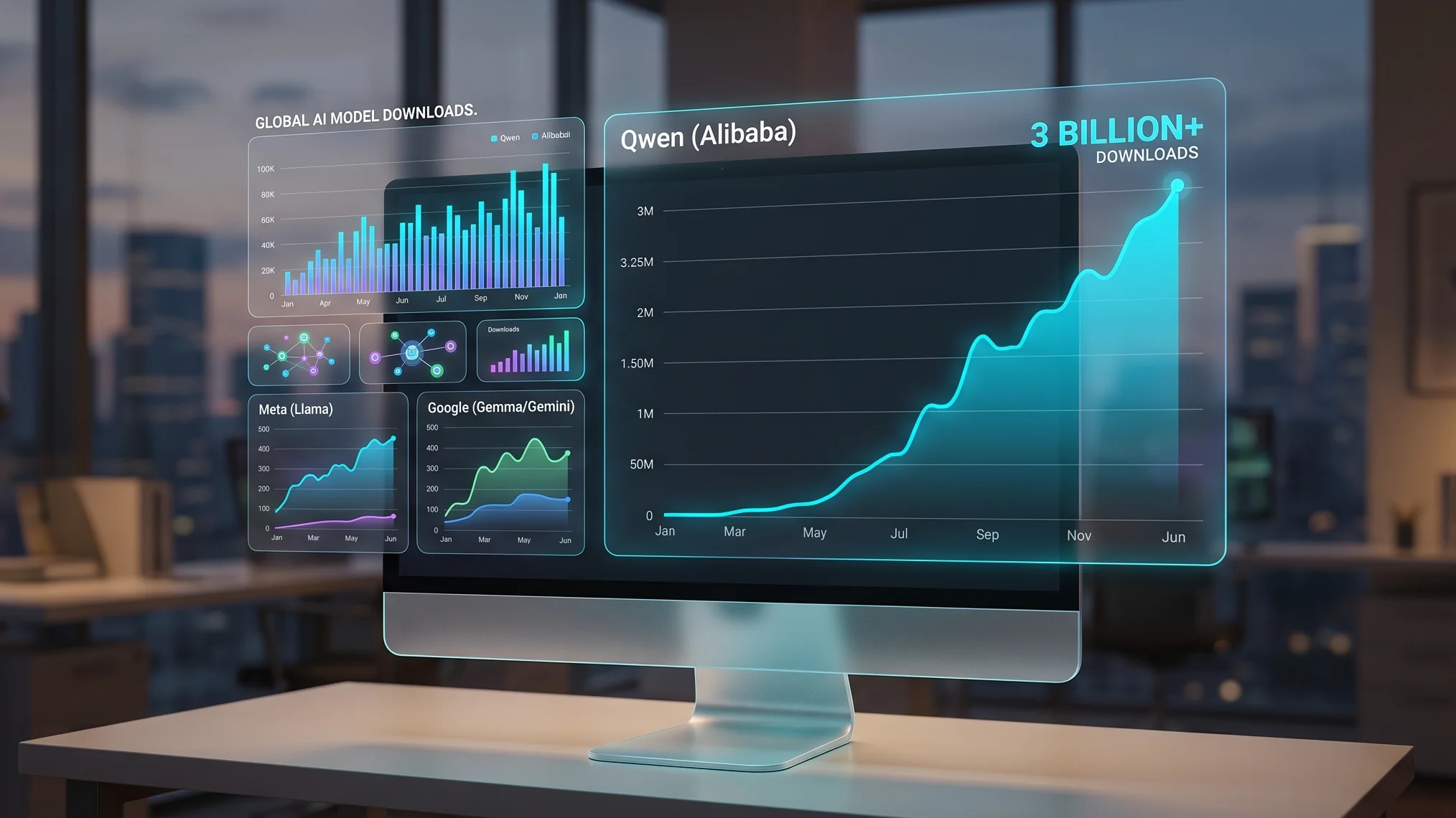
Chinese technology corporation Alibaba has documented a substantial increase in international developer interest regarding its Qwen family of open-source artificial intelligence models. According to official findings published by the Hugging Face platform, which monitors engineering activity across the machine learning community, total downloads for Qwen base models have exceeded the milestone of 3 billion instances. This metric was derived from platform logging data over the last six months and reflects a fundamental transition in architectural priorities across the generative software ecosystem. To contextualize the scale of competing platforms, open-source models from Google, particularly the Gemma series, recorded approximately 227 million downloads, while Meta’s Llama lineup gathered roughly 418 million downloads over the identical analytical window.
The accelerated traction of these foundation weights came as an unexpected development for numerous industry observers who historically anticipated uninterrupted dominance by North American tech firms. Hugging Face records demonstrate consistent momentum from software teams systematically adopting, fine-tuning, and integrating Alibaba’s frameworks into production-grade enterprise software. The structural dynamics of the open-source market emphasize that flexibility and accessible deployment pipelines are primary factors when choosing baseline models for enterprise application stacks.
Methodology and Tracking Infrastructure
Metrics gathered by Hugging Face rely on a telemetry framework that accounts for much more than basic manual browser downloads of archive repositories. The platform’s automated backend tracks several foundational categories of network transactions
- Programmatic API requests generated during cloud server provisioning, cluster scaling, and Docker container initialization.
- Continuous integration CI/CD testing pipelines where model checkpoints are retrieved dynamically to validate functional code integrity.
- Direct repository synchronization executed via Git version control tools and native Python machine learning modules.
- Downstream derivative traffic produced when engineers access specialized community adaptations constructed on top of base weights.
The open-distribution strategy of over 460 official Qwen checkpoints and more than 300,000 community derivatives created through domain-specific fine-tuning triggers an expanding multiplier effect. Every fine-tuned release shared on the public registry generates recursive network traffic during evaluation and validation workflows by global engineering teams.
Architectural Highlights and Parameter Spectrum
The engineering roadmap pursued by Alibaba Cloud diverges substantially from the strategies employed by Western competitor labs. Rather than restricting output to a handful of massive monolithic checkpoints, the engineering group developed a continuous spectrum of models designed for disparate hardware environments. The portfolio encompasses ultra-lightweight 0.5-billion parameter builds capable of on-device processing on ARM architectures, extending up to comprehensive 110-billion parameter systems built for distributed high-performance computing clusters.
The fundamental topology incorporates optimized Transformer layers with native Grouped-Query Attention (GQA). This design minimizes Key-Value (KV) cache memory footprint, which is instrumental in sustaining high throughput across graphical processing units when handling prolonged context windows.
Multilingual Tokenizer and Vocabulary Compression
A critical engineering differentiator of the Qwen framework is its proprietary tokenizer architecture. Featuring an expansive lexicon of over 151,000 distinct tokens, it easily outperforms the vocabulary density of legacy open architectures. Through optimized sequence parsing, the tokenizer provides dense text compression across non-Latin scripts, including Cyrillic and East Asian writing systems. Fewer generated tokens per given passage directly lowers execution latency and reduces Time to First Token (TTFT).
In enterprise cloud deployments where inference expenses typically scale between 0.20 USD and 0.90 USD per million generated tokens, this structural efficiency provides measurable operational expenditure savings for commercial projects.
Comparative Evaluation of Open Frameworks
Evaluating the present ecosystem landscape requires a technical comparison of flagship open-weight solutions published by Alibaba, Meta, and Google. The table below details key performance and architectural parameters across the primary model series.
Licensing Frameworks and Commercial Compliance
Legal compliance surrounding open-source models is a decisive criterion for enterprise adoption. The majority of Qwen model releases are published under the permissive Apache 2.0 standard. This license grants businesses unrestricted rights to modify source code, deploy weights in isolated private environments, and embed systems within commercial closed-source software without royalty requirements.
In comparison, Meta’s Llama Community License incorporates a usage threshold requiring formal commercial authorization if a product reaches more than 700 million monthly active users. While this ceiling is rarely encountered by startups, corporate risk management teams frequently favor standard OSI-approved licenses to mitigate long-term intellectual property ambiguities.
Deployment Methodologies and Weight Quantization
The swift uptake of Qwen models is supported by extensive compatibility with modern inference optimization stacks. Developers routinely deploy checkpoints across self-hosted clusters using battle-tested serving engines
- Inference runtimes like vLLM and TGI which maximize GPU utilization through continuous batching and PagedAttention logic.
- Desktop engines like Ollama and LM Studio providing instant zero-configuration testing on developer workstations.
- Nvidia TensorRT-LLM runtimes targeting peak compute efficiency and low-latency response delivery on enterprise hardware.
Modern quantization methods, particularly AWQ (Activation-aware Weight Quantization) and GPTQ, play an indispensable role in operational cost reduction. These mathematical algorithms downscale weight precision from 16-bit floating-point representations (FP16 or BF16) to 4-bit integer values (INT4). Consequently, a massive 72-billion parameter model, normally demanding over 140 GB of dedicated VRAM, can execute reliably on dual-GPU servers configured with 24 GB VRAM per card.
Model Customization and Fine-Tuning
Adapting foundation weights to specialized enterprise workflows requires structured domain datasets. Modern parameter-efficient fine-tuning (PEFT) frameworks, including LoRA and QLoRA, make targeted model training accessible on standard hardware setups. Compute rental costs for execution typically range between 50 USD and 350 USD per training session, allowing lean development teams to build customized domain models without significant capital outlays.
Economic Shifts in Enterprise Cloud Computing
The sustained momentum of the Qwen framework highlights a strategic rebalancing away from proprietary vendor lock-in. Technology organizations are evaluating the ongoing costs of proprietary inference APIs for heavy transaction loads. Deploying optimized open-weight systems on dedicated bare-metal infrastructure (costing roughly 250 – 450 USD monthly) establishes cost predictability, enhances system resilience, and ensures absolute data governance for sensitive business processes.
Ongoing contributions to the Qwen open-source repository continue to decentralize advanced artificial intelligence research, creating a resilient competitive environment for software engineering teams globally.



0 Comments