
A New Stage in Digital Healthcare by Microsoft
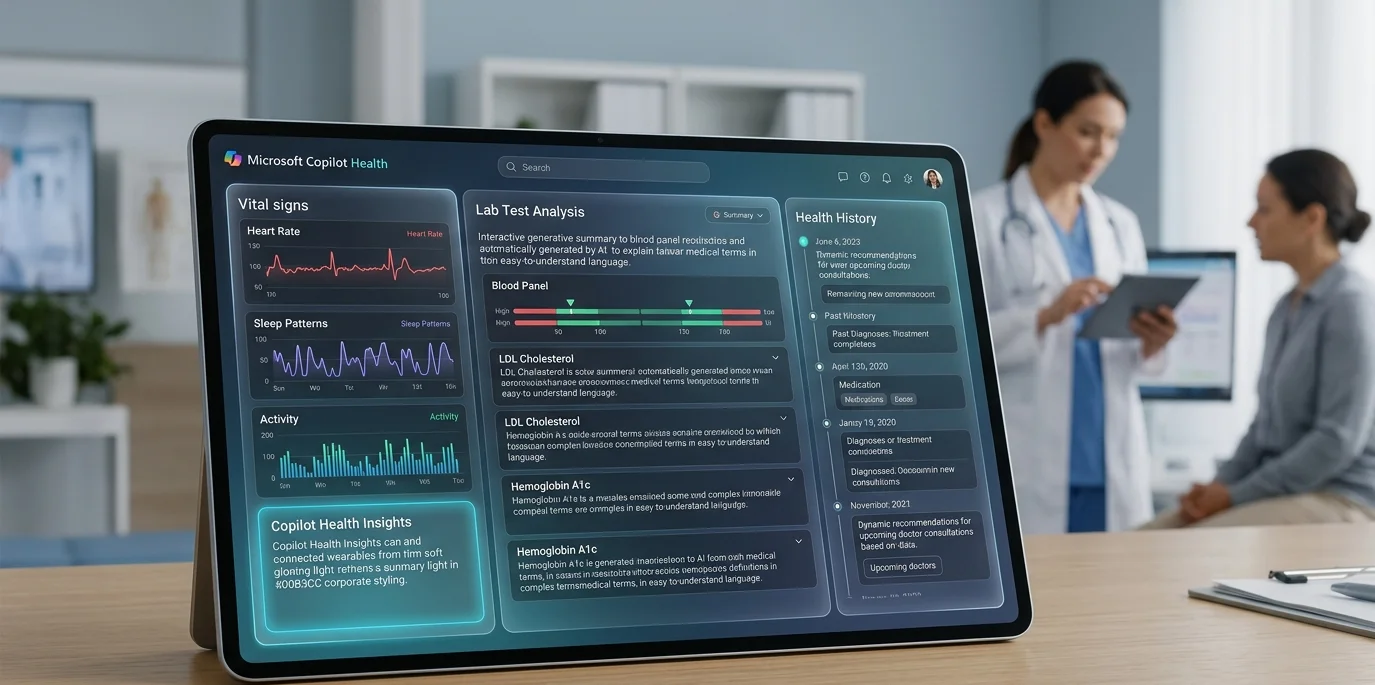
Microsoft Corporation has officially moved its specialized assistant, Copilot Health, into the public preview phase within the United States. This project was engineered to address the complexities patients encounter when navigating the modern healthcare environment, where the sheer volume of documentation frequently impedes effective health tracking. The platform operates as a secure, cloud-protected hub that aggregates disparate information sources into a single stream.
The primary goal of the system is to convert dense clinical records, laboratory PDF readouts, and daily metrics from consumer electronics into a structured, highly legible data ecosystem. The artificial intelligence steps in as a personal health analyst, assisting users in preparing for productive consultations with medical experts.
Core Capabilities and Data Processing Workflows
Copilot Health relies on deep infrastructure integration with Microsoft Cloud for Healthcare, employing fine-tuned language models proficient in recognizing specialized clinical nomenclature and terminology. The pipeline accepts PDF attachments, scanned documents, and direct digital extractions from electronic health records.
The foundational features are organized into several operational vector pathways
- Automated interpretation of blood, urine, and metabolic markers with contextual explanations of normal reference ranges
- Compilation of a longitudinal chronological timeline detailing past conditions and medical interventions
- Native synchronization with popular wearable ecosystems to capture real-time heart rate, sleep architecture, and movement metrics
- Algorithmic synthesis of personalized question lists prior to scheduled physician appointments
By reviewing long-term historical records, the underlying algorithms discern broader trend patterns that an individual might overlook when reviewing isolated paper documents. This shifts user attention away from looking up acronyms and toward actionable health optimization.
Technical Specifications and Ecosystem Compatibility
To maximize platform utility, developers implemented native compliance hooks for major healthcare registries and commercial hardware providers. This ensures seamless data ingestion without necessitating manual record replication.
The solution is explicitly designed to optimize the conventional 15-minute consultation window. When a patient arrives equipped with a structured textual synthesis and explicit questions concerning their physical telemetry trends, clinicians spend fewer minutes sorting through legacy charts. This streamlined approach minimizes conversational friction and allows the care team to focus directly on medical advice rather than document gathering.
Furthermore, the visual interface correlates objective laboratory metrics with personal habit data. This enables individuals to actively track how structural lifestyle interventions, such as adjusted rest cycles or daily caloric expenditure, express themselves within standard diagnostic test outputs over quarterly observation intervals.
Privacy Protections and Medical Confidentiality
Handling highly private physiological data remains a primary challenge when deploying artificial intelligence in public sectors. Microsoft emphasizes that Copilot Health runs on an architectural framework engineered around complete user isolation. Uploaded health metrics, clinical assets, and diagnostic reports are strictly excluded from global model training pipelines and are never exposed to external vendor organizations.
The entire system infrastructure meets strict HIPAA compliance demands and localized privacy statutes. Access points are secured behind multi-factor authentication protocols, and users maintain the granular capacity to revoke synchronization permissions for any connected lab or wearable platform at any moment.
Scope and Constraints of the Preview Version
During its initial public testing stage, the utility features several notable boundaries. Access is restricted to adult users aged 18 and older residing within United States territories. The platform operates exclusively in the English language due to its foundational reliance on localized nomenclature standards and domestic clinical databases. The engineering teams explicitly state that the assistant does not offer formal medical diagnostic opinions or therapeutic prescriptions, serving purely as an informational data-structuring tool.




0 Comments