
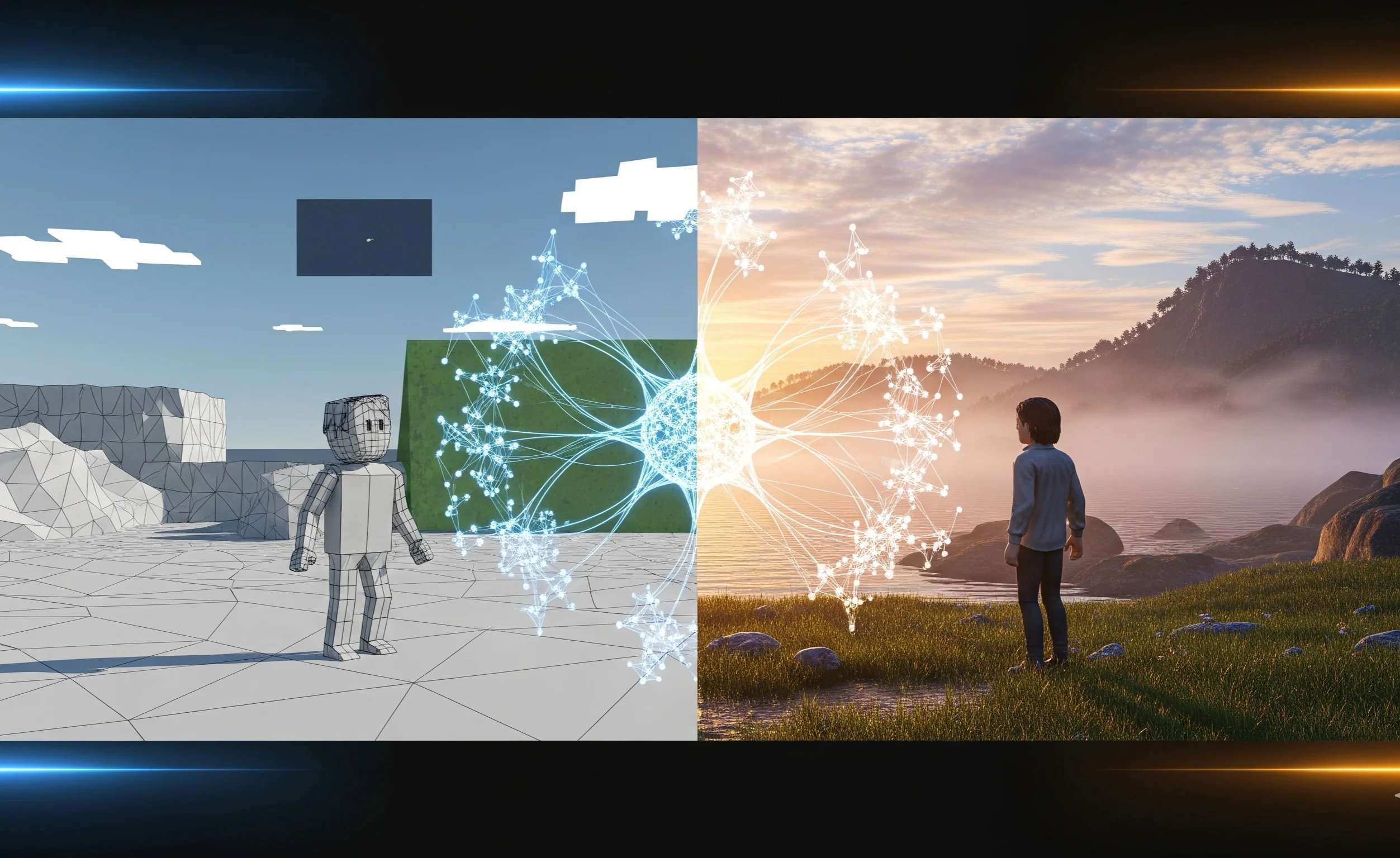
The world of computer gaming is constantly evolving, and today the biggest changes are happening at the intersection of technology and art. Nvidia is taking a revolutionary step by introducing neural rendering – a new era in game graphics. It’s no longer just a race for more polygons or higher resolutions. Thanks to artificial intelligence, game worlds are now generated on the fly, achieving a level of photorealism previously thought impossible and opening up new horizons for developers and players. This technology has the potential to completely change our understanding of visual content.
How does neural rendering work?
Traditional rendering, used for decades, builds images based on mathematical models and geometric shapes. Instead, neural rendering harnesses the power of AI, training a neural network to reproduce a realistic world. This network analyzes massive amounts of data to understand how light, shadows, and textures behave under different conditions. For example, Neural Radiance Fields (NeRFs) technology allows for the creation of full-fledged 3D scenes from ordinary 2D photographs. The neural network “invents” unrecorded details, generating missing angles and reflections, making the final result incredibly realistic.
A Revolution for Developers: Speed and Efficiency
Neural rendering not only improves graphics quality but also simplifies the creation process. For developers, this means less repetitive work and more creative opportunities. Instead of spending hours creating each texture and simulating complex lighting effects, AI can do it automatically.
- Simplifying Workflow: Nvidia provides tools that automate texture and lighting creation, allowing designers and artists to focus on the overall design.
- Resource Optimization: Less manual content creation saves time and budget, which is key in the gaming industry.
- Scalability: The technology allows graphics to be easily adapted to different devices, from PCs to consoles, without significant effort.
What does this mean for players?
For players, the transformation of game graphics represents a qualitatively new level of visual immersion. Ray tracing combined with neural rendering delivers incredible realism.
- Unprecedented realism: Reflections of light and shadow, dynamic textures and realistic reflections make the game world almost different from the real one.
- New experience: Graphics generated on the fly allow for more dynamic worlds that change based on the player’s actions.
- Improved performance: Technologies like Nvidia DLSS use neural networks in games to upscale images, allowing you to run games at high resolutions without losing performance.
Challenges and the future of technology
Although Nvidia has already made significant progress in this area, the technology is still in its infancy. The main challenge is the high computing power required to run neural networks in real time. This is currently being partially offset by new GPU architectures, but further development is required for full implementation. However, despite this, the future of gaming graphics undoubtedly belongs to AI. With each passing year, models are becoming more efficient and hardware more powerful.
In conclusion, Nvidia has once again confirmed its market leadership with the introduction of neural rendering. This isn’t just another update, but a true revolution, uniting AI and visual art. This technology paves the way for the creation of game worlds that not only look but also behave like real ones, offering players a completely new level of immersion. This is a significant step forward, defining the development of gaming technologies in the coming years.




0 Comments