
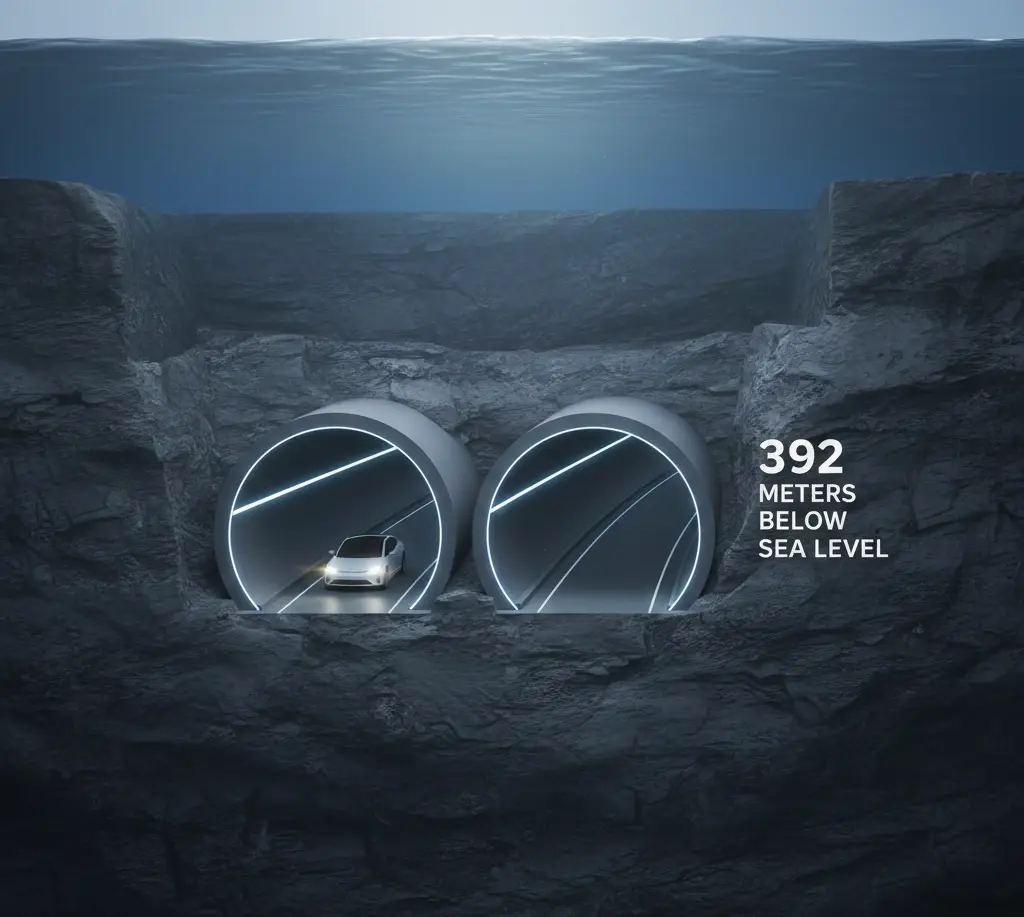
Norway, a land of fjords and majestic landscapes, is once again confirming its status as a global leader in infrastructure construction. The country is currently implementing a project that surpasses all existing analogues: the construction of Rogfast. This longest underwater tunnel and deepest road in the world is more than just a road section; it is a monumental engineering challenge that will transform the logistics of an entire region. It will become a key link in the strategic E39 route, significantly reducing travel times between key cities.
Location and Scale: Characteristics of the Rogfast Tunnel
The Rogfast Tunnel is located on Norway’s west coast, in the Rogaland region, and is designed to directly connect two major cities: Stavanger and Haugesund. This construction is part of the ambitious Ferry-Free E39 project, which aims to replace most of the traffic-congesting ferry crossings with permanent road connections. Rogfast’s key features are impressive:
- Length: The total length of the tunnel will be approximately 27 kilometers, making it the absolute world record holder among underwater auto tunnels.
- Depth: The world’s deepest auto tunnel will plunge to an incredible 392 meters below sea level. This depth requires unique engineering solutions to ensure the safety and stability of the structure.
- Design: The tunnel consists of two separate tunnel tubes (each for two traffic lanes), which significantly improves safety and throughput compared to single-tube designs.
Depth and Technology: Engineering Challenges “Underwater”
Construction at a depth of almost 400 meters below the sea surface presents numerous engineering challenges. The primary water pressure at such depths is colossal. To counteract this and ensure the durability of the structure, builders use state-of-the-art technologies:
- Hard Rock Drilling: Much of the tunnel passes through hard rock, requiring the use of heavy-duty drilling equipment and specialized blasting techniques to minimize environmental impact.
- Watertightness: Ensuring a complete seal is critical. Innovative injection methods (injecting special mixtures into rock cracks) are used to prevent water leakage.
- Slope and Safety: To ensure driver comfort and safety, the maximum road gradient in the tunnel should not exceed 5%. This results in an extremely long and gradual descent and ascent to the surface, adding kilometers to the overall length.
Particular attention is paid to ventilation systems. Ventilation shafts, traditional for shorter tunnels, are impractical and too expensive at such depths. Instead, powerful longitudinal ventilation systems, controlled by computer models, are used to effectively remove exhaust gases and smoke during a fire.
Economic Feasibility and Cost of the Rogfast Project
Although Rogfast’s construction is extremely expensive, the economic benefits are estimated to significantly outweigh the costs. The total project cost is estimated at $2.5–3 billion (subject to final adjustments and inflation). Funding is provided by the Norwegian state budget, and partly through the toll road system, a common practice for large infrastructure projects in the country.
- Time reduction: The most noticeable positive effect will be a reduction in travel time between Stavanger and Haugesund from approximately 90 minutes (including waiting for the ferry) to less than 40 minutes via the tunnel.
- Economic Stimulation: A continuous and rapid combination will promote trade, tourism and the labor market, uniting two major urban regions into a single economic zone.
- Environmental benefit: Eliminating several large fuel-burning ferries will result in a significant reduction in carbon dioxide emissions, which is in line with Norway’s environmental priorities.
E39: Rogfast as Part of the World Infrastructure Plan
The Rogfast E39 tunnel is just one, albeit the most extensive, part of a grand plan to modernize the European route E39, which stretches along Norway’s entire west coast. This project, known as the “Ferry-Free E39,” represents the government’s strategic vision for creating a seamless, fast, and high-quality transport corridor.
The completion of Rogfast will be a powerful catalyst for other infrastructure projects utilizing cutting-edge technology. Even with its high cost, the experience gained during Rogfast’s construction will be invaluable to the global engineering community, offering ready-made solutions for similar challenges anywhere in the world. The world’s deepest auto tunnel is a clear demonstration of how technology and bold planning can overcome even the most complex geographic barriers.
While construction is underway, the Rogfast project has already become a symbol of engineering determination. Its successful completion (scheduled for the mid-2030s) will usher in a new era of transportation, proving that there are no obstacles modern engineering cannot overcome.

0 Comments